
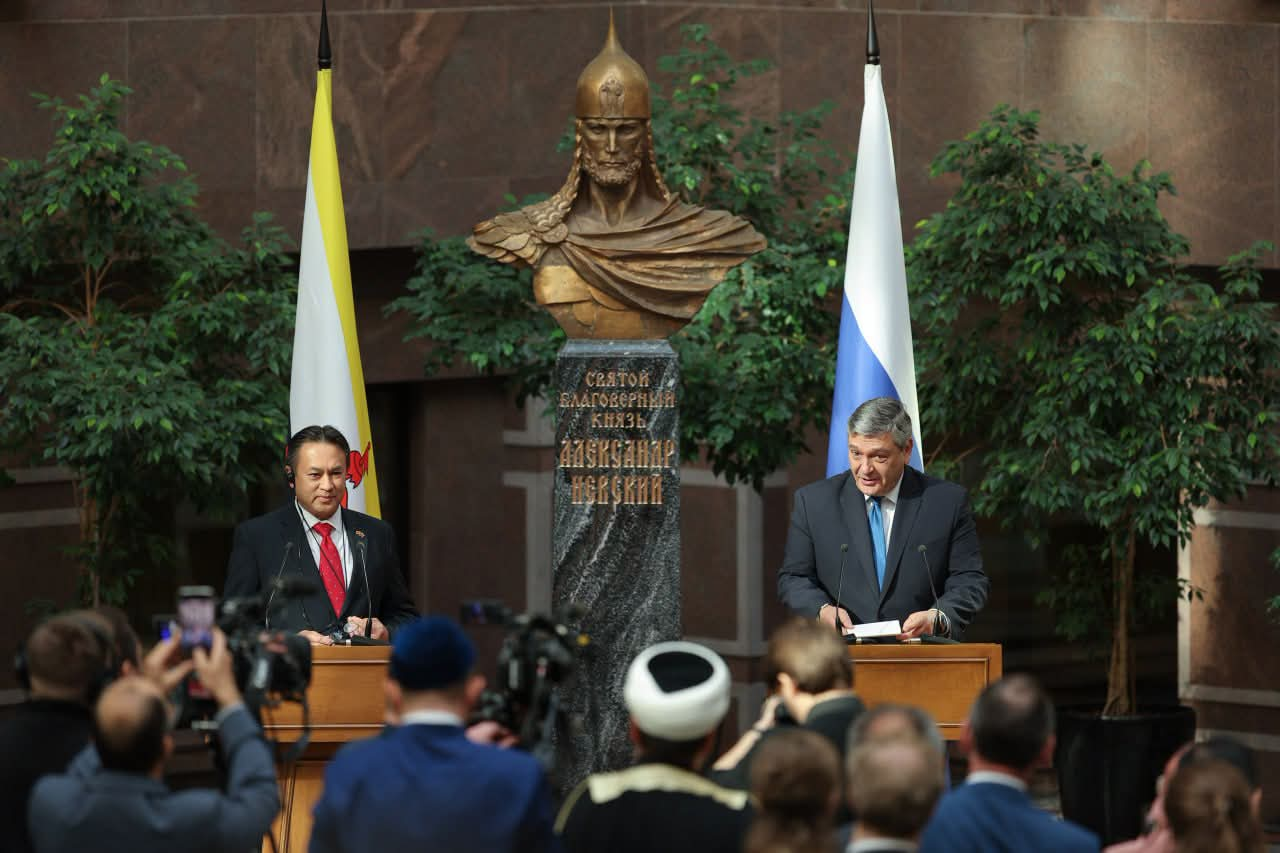
Strengthening political dialogue in a changing international environment.
The first issue is political.
Russia and Brunei have emphasised their shared or closely aligned positions on a number of international and regional issues. This creates room for regular consultations at a time when the international system is undergoing significant geopolitical changes.
For Moscow, maintaining dialogue with Southeast Asian states remains important to its broader foreign-policy engagement in the Asia-Pacific region.
For Brunei, relations with Russia form part of a wider network of diplomatic partnerships that allows the country to maintain dialogue with different international actors.
The bilateral relationship also benefits from its ASEAN dimension. Brunei's membership of ASEAN means that its relations with Russia exist within a broader regional framework involving dialogue between ASEAN and major external partners.
The challenge for both countries will be to transform political convergence into sustained institutional dialogue and practical cooperation.
Turning diplomatic ties into stronger economic cooperation.
The second major issue is economic.
Trade and investment were explicitly identified as areas where Russia and Brunei want to deepen their cooperation.
The broader ASEAN–Russia economic relationship provides an important context. ASEAN reported merchandise trade with Russia of approximately US$17.8 billion in 2025, while the two sides adopted a Strategic Programme on Trade and Investment Cooperation for 2026–2035.
These figures concern ASEAN–Russia relations as a whole and should not be interpreted as bilateral Russia–Brunei trade figures. However, they demonstrate the wider economic framework in which Moscow and Bandar Seri Begawan are seeking to develop their relationship.
For Brunei, new international partnerships can contribute to economic diversification and access to investment and technology.
For Russia, closer economic engagement with Southeast Asia can create opportunities in areas such as energy, infrastructure, technology, agriculture, logistics and industrial cooperation.
The key question is therefore whether the political relationship can generate concrete commercial projects and greater business-to-business engagement.
Defence and security: a regional dimension.
Security represents another important component of the meeting.
Both sides identified defence and security as areas for deeper cooperation. This is significant because Southeast Asia occupies an increasingly important position in discussions about regional stability and international security.
ASEAN has developed a broad network of dialogue mechanisms involving its member states and external partners. Its approach places considerable emphasis on dialogue, inclusiveness and ASEAN-led regional mechanisms.
Russia's engagement with Southeast Asian countries also includes discussions on strategic stability, non-proliferation and traditional and non-traditional security challenges.
For Brunei, closer security dialogue with Russia must therefore be viewed alongside its relations with other regional and international partners.
For Moscow, strengthening ties with ASEAN members provides another channel for maintaining political and security dialogue in Southeast Asia.
The issue is not simply bilateral defence cooperation, but how such engagement fits into the wider regional security architecture.
Russia–Brunei ties and the future of ASEAN engagement
The fourth issue is perhaps the broadest: the future of Russia's relationship with Southeast Asia.
Brunei's importance to Moscow cannot be measured only by the size of its economy or population. As an ASEAN member, the country is part of one of the world's most important regional organisations.
In 2026, ASEAN and Russia marked 35 years of relations and adopted a new Comprehensive Plan of Action for 2026–2030, covering areas including political and security cooperation, trade, investment, energy, science and technology, education and people-to-people exchanges.
This provides a broader framework for bilateral relationships between Russia and individual ASEAN members.
For Brunei, cooperation with Russia can complement its broader international partnerships while allowing it to participate in regional and multilateral dialogue.
For Russia, closer relations with Brunei and other ASEAN states contribute to maintaining diplomatic and economic links with Southeast Asia.
The participation of other ASEAN ambassadors in the October 2 event in Moscow was therefore noteworthy. It gave the anniversary a regional dimension beyond the two countries themselves.
A relationship entering a new phase.
The 35th anniversary of Russia–Brunei diplomatic relations is ultimately about more than commemorating three decades of bilateral ties.
The meeting in Moscow highlighted four interconnected priorities: political dialogue, economic cooperation, security and Russia's wider engagement with ASEAN.
The foundations of the relationship have already been established. The challenge now is to determine how effectively both sides can translate diplomatic goodwill into concrete cooperation.
With ASEAN–Russia cooperation entering a new phase toward 2030, and trade and investment cooperation looking toward 2035, the coming decade could provide a new test for the Russia–Brunei partnership.
For Moscow and Bandar Seri Begawan, the anniversary marks a moment to look back at 35 years of diplomatic relations—but also to define what those relations can deliver in the years ahead.
Xandra Beyene.
Media Coverage
(+237)694810981
Commentaires 0
Soyez le premier à réagir à cet article.
Laisser un commentaire