
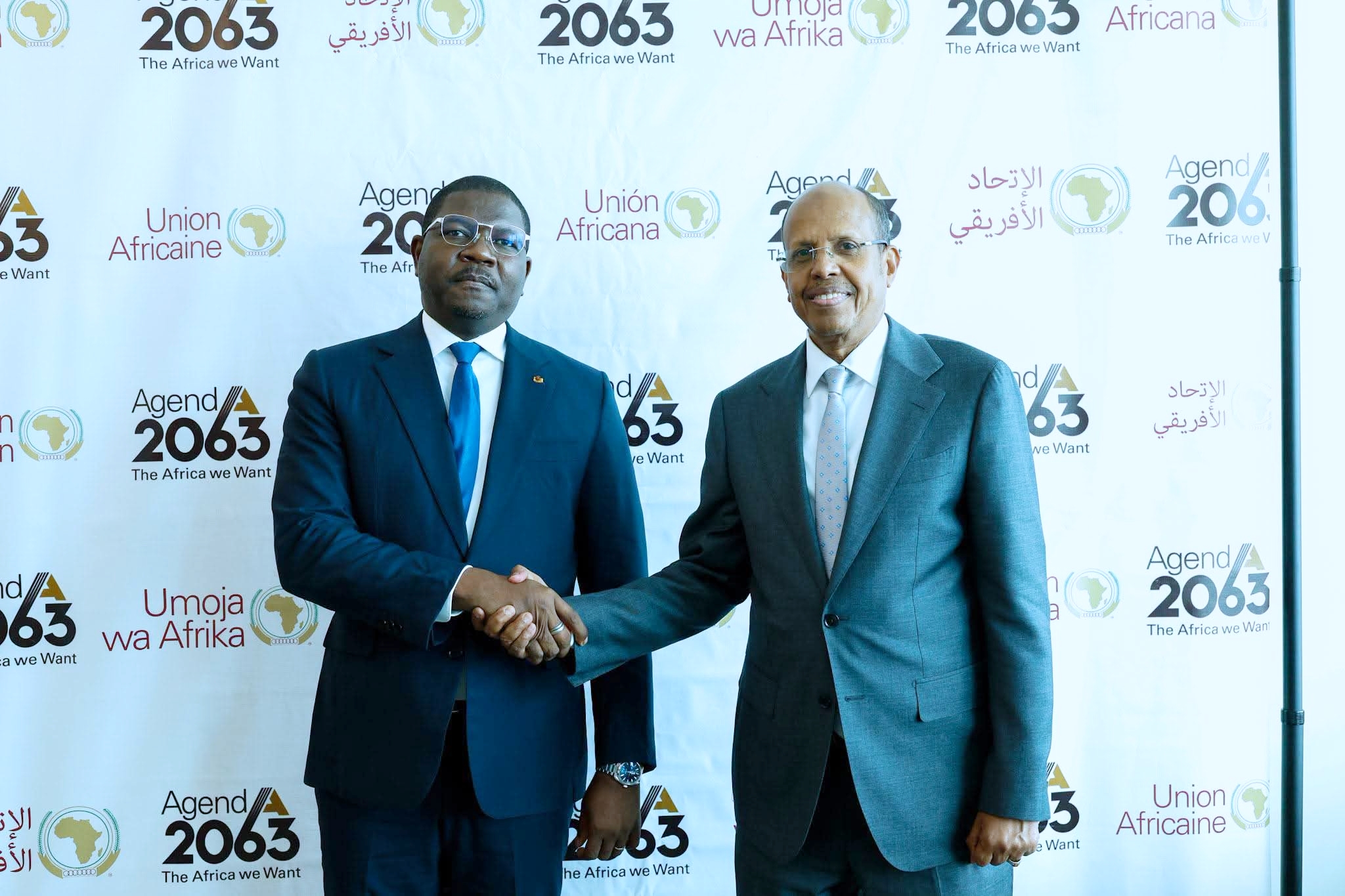
A diplomatic meeting with regional implications.
The meeting between Mahmoud Ali Youssouf and Ilídio Vieira Té comes at a sensitive moment for Guinea-Bissau.
The African Union’s message is centered on three interconnected objectives: peace, stability and the restoration of constitutional order.
For the AU, the challenge is therefore not simply to support transitional authorities. It is also to uphold a fundamental principle of the African Peace and Security Architecture: political transitions should ultimately lead back to a constitutional framework and a legitimate electoral process.
The African Charter on Democracy, Elections and Governance places constitutionalism, regular and transparent elections, and the rejection of unconstitutional changes of government among its core principles.
Guinea-Bissau as a test for Africa’s peace architecture
The situation in Guinea-Bissau is therefore also a test of collective African diplomacy.
In March 2026, the AU Peace and Security Council called for the implementation of a transition roadmap and emphasized the importance of an inclusive transitional government and conditions conducive to elections planned for December 2026.
It also called for close coordination between the African Union, ECOWAS and the CPLP.
The issue goes beyond the organization of an election. A sustainable political transition requires institutions capable of managing political competition, preventing renewed instability and restoring confidence in the constitutional system.
The challenge of inclusiveness
One of the central issues is the inclusiveness of the transition.
The AU has emphasized the participation of political forces, civil society, women and young people in the process.
This reflects a wider concern across Africa: when political transitions are primarily managed by state institutions, military actors or established political elites, significant sections of society may remain outside the process.
Inclusiveness is therefore not only a democratic principle. It can also contribute to preventing renewed political tensions.
For Guinea-Bissau, the challenge is to build a transition broad enough for the country's different political and social constituencies to participate in shaping the country's return to constitutional rule.
The military-civilian relationship remains central
Another major issue is the relationship between civilian institutions and the armed forces.
In previous statements on Guinea-Bissau, the AU Peace and Security Council called for respect for constitutionalism and for the military to refrain from political interference. It also stressed the importance of security-sector reform and stronger civilian oversight.
This question has continental significance.
Across Africa, recent political crises have brought the role of the military in governance back to the centre of political debate. In Guinea-Bissau, the transition therefore also raises the question of how to establish durable institutional boundaries between civilian political authority and the security establishment.
A shared responsibility for African institutions.
The Guinea-Bissau situation also highlights the importance of coordination between African regional and continental organizations.
The African Union, ECOWAS and the CPLP have different institutional mandates and political roles. Their ability to coordinate their efforts will be important to the success of the transition.
For the African Union, Guinea-Bissau consequently represents an opportunity to demonstrate how continental and regional mechanisms can work together rather than operate through parallel diplomatic processes.
From transition to elections
The next major stage will be the transition from political arrangements to an electoral process.
The December 2026 electoral timetable gives the transition a concrete political horizon. The question will be whether the institutions and stakeholders involved can create the conditions required for a credible return to constitutional governance.
The New York meeting should therefore be viewed not as an isolated diplomatic encounter, but as part of a broader process involving Guinea-Bissau, the African
Union and regional partners.
A question of institutional credibility
Ultimately, the Guinea-Bissau transition also concerns the credibility of Africa's continental peace and governance architecture.
The African Charter on Democracy, Elections and Governance calls for constitutional civilian control of the armed forces, political dialogue and effective citizen participation.
The key question now is how these principles will translate into concrete institutional, political and electoral outcomes in Guinea-Bissau.
The meeting in New York sends a clear diplomatic message: the African Union intends to accompany Guinea-Bissau towards peace, stability and the restoration of constitutional order. The next challenge will be turning that commitment into a sustainable political and institutional process.
Charles Fils Elangue
Media coverage
(+237)694810981
Commentaires 0
Soyez le premier à réagir à cet article.
Laisser un commentaire